

The Spirit of Community in Delano is defined by the
Creativity, Resilience, and Community Investment of its people.
Plotnik’s Blacksmith
EST. 1889
For more than a century, Plotnik’s Blacksmith Shop stood as a reminder of the craftsmanship, ingenuity, and work ethic that helped build the Delano community. Founded in 1887 by Polish immigrant and blacksmith Paul Plotnik, the business grew from a small rented shop into a thriving operation producing and repairing the wagons, farm implements, tools, and equipment needed by a growing agricultural community. Paul’s son Louis joined the business, and later generations adapted the shop as horses gave way to tractors and modern machinery, creating everything from flagpoles and church crosses to custom metalwork. Although the forge eventually quieted, the Plotnik family’s long tradition of blacksmithing and community service remains an important link to Delano’s early history and the skilled trades that helped shape the town.
“Strike While the Iron’s Hot.”
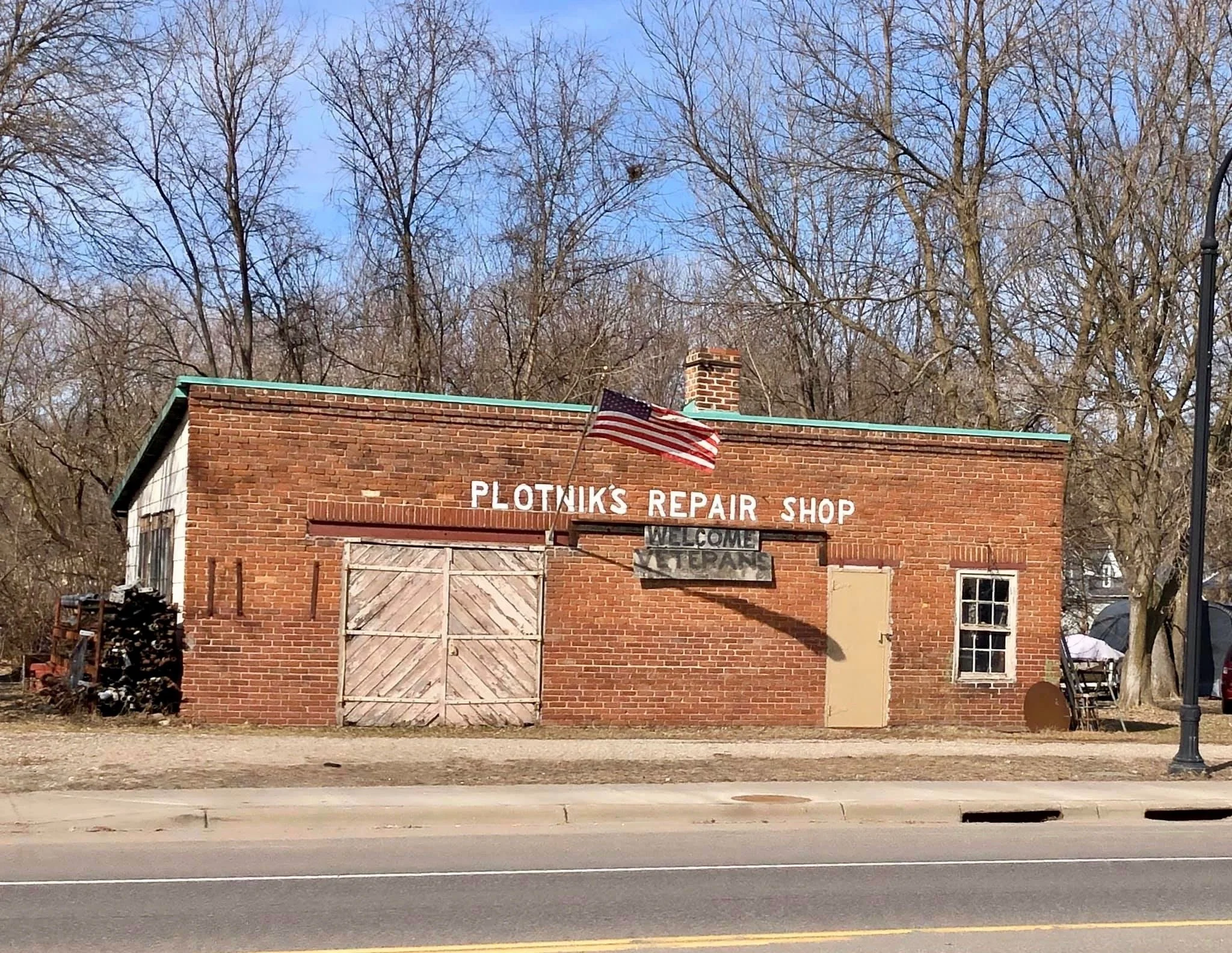
In the corridors of humanity, on the paths of ingenuity and imagination, legends are made. Some are heroic and dramatic; some are minor and modest. Legends are stories of human growth, the evolution of mind and matter, and the records of people. Undimmed and undarkened, both prominent and modest, Plotnik’s Blacksmith Shop is a local legend. It stands on Highway 12 as a testimony to the work ethic and civic values that helped establish the Delano community on the South Fork of the Crow River.
The city of Delano was founded in 1868 and incorporated in 1876. In 1887, a Polish immigrant, Paul Plotnik, born on January 15, 1869, immigrated from his home in the Oppeln, upper Silesia, Poland. He was a locksmith by trade and came to America seeking new ideas, skills and opportunities. Before settling in Delano, Plotnik lived in other Minnesota communities and honed his skills as a blacksmith and farrier. He opened his first shop in 1889, renting a small building on the corner of River Street and Elm Avenue. As the city grew and agriculture became diverse, there was need for multiple tools, implements, devices, and gadgets to meet the demands of mid-century America’s expansion in industry, agriculture and commerce. Plotnik built a larger shop in 1891 on the other side of River Street, the area later occupied by Delano Granite Works display area.
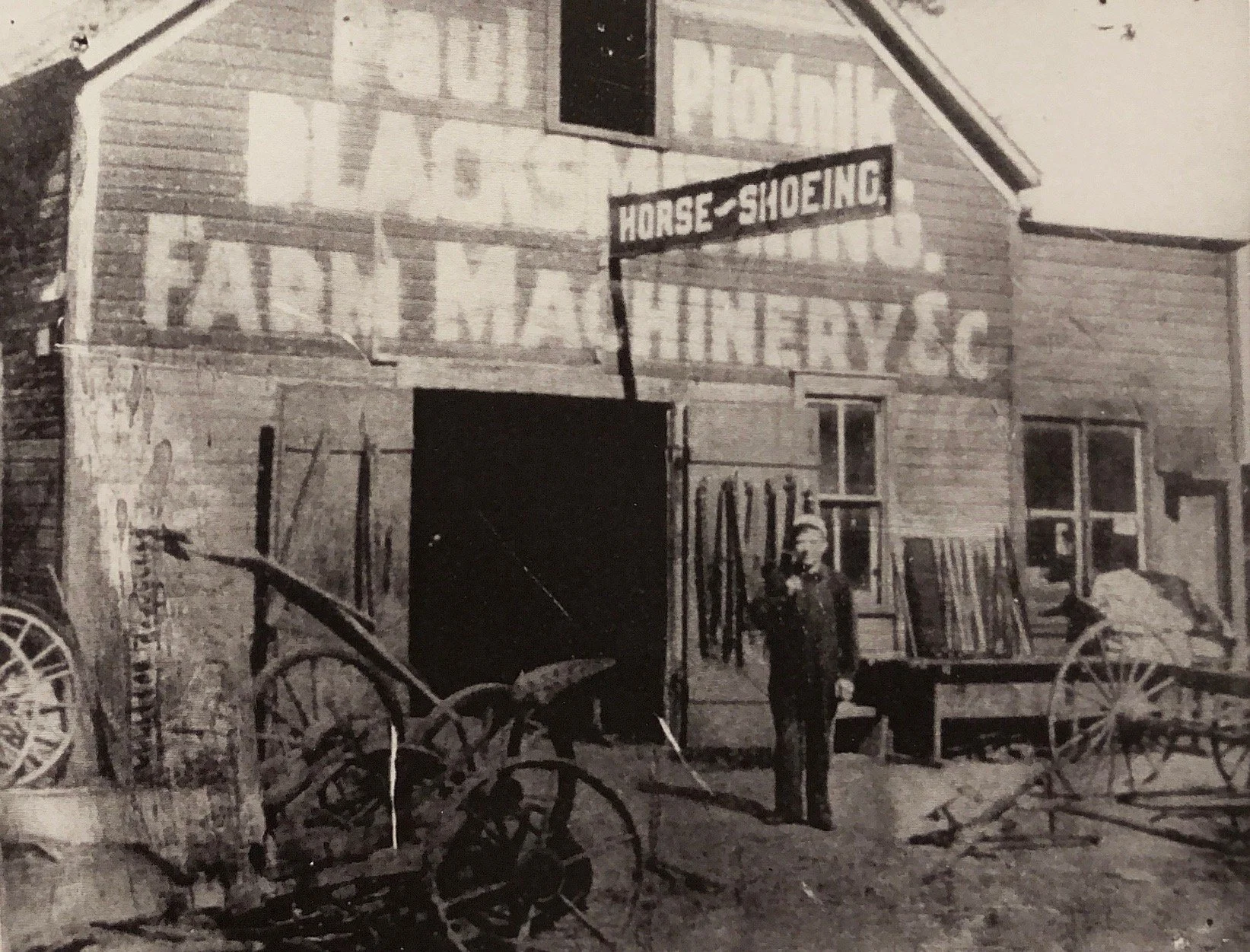
Louis Plotnik, Paul’s younger brother, worked for him as a blacksmsith.
Plotnik continued to expand his business, eventually adding two warehouses in addition to the main building.
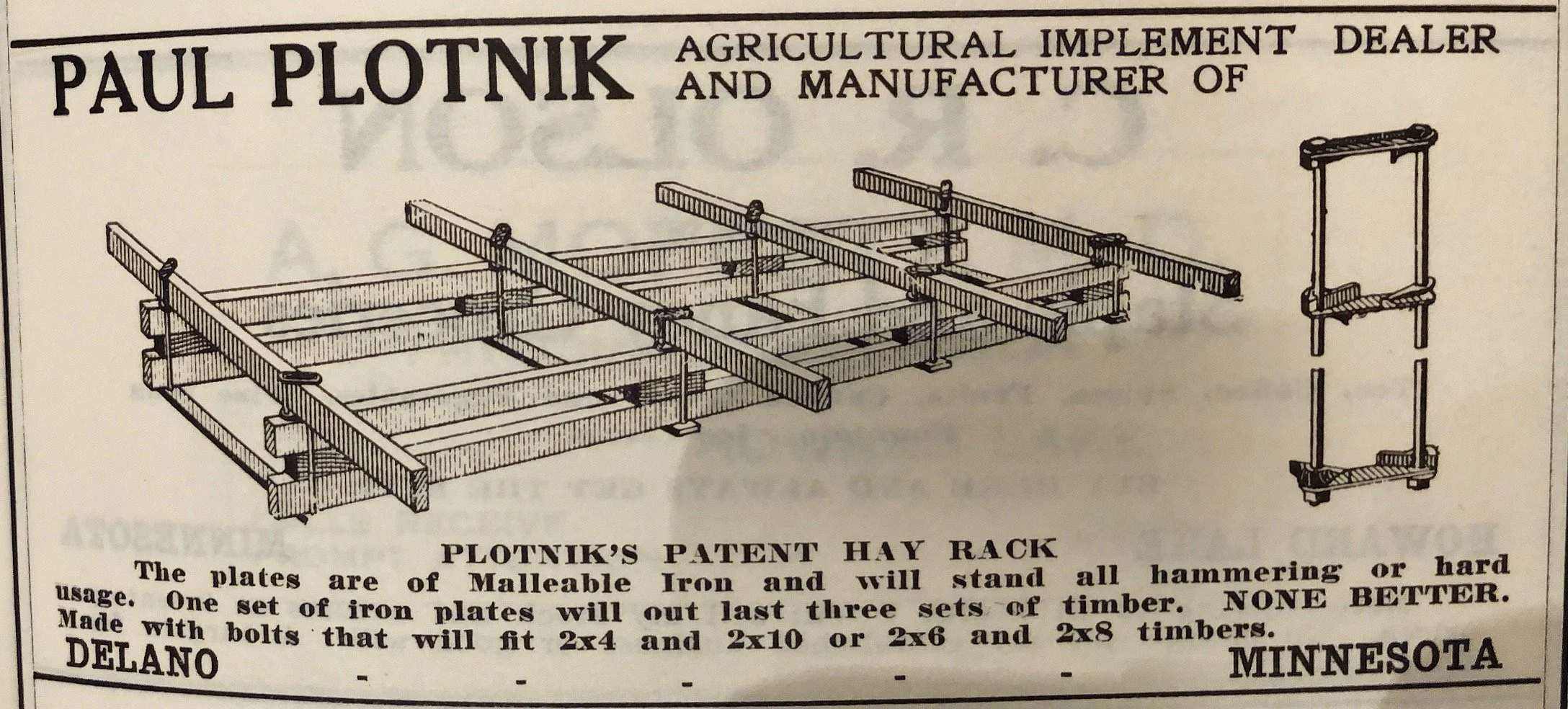
(from The Great Northwest Magazine, December 1909)
PAUL PLOTNIK - A city which receives the amount of grain first hand that Delano does must of necessity and naturally have a very large trade in agricultural implements and machinery. Mr. Paul Plotnik has an establishment containing a full line of farm machinery, buggies, wagons, bob sleighs, hayracks, wagon boxes and spring seats. This immense stock is housed in a building 24x40, with an addition 10x40 and in connection are two warehouses, 36x50 and 16x36. Three competent men are employed in the manufacture of wagons, seats, bobs and hay racks, the last of which is widely known as Plotnik’s patent hay rack. Mr. Plotnik has been engaged in business here for eighteen years. To have an inventor, who through careful thought and investigation of means and ways has been able to give to the community a product so complete in its mechanism, so substantial in its structure, is an honor few cities can boast of. Mr. Plotnik also conducts a first class blacksmith and horse shoeing shop and in this line has the liberal support of all Wright county farmers.”
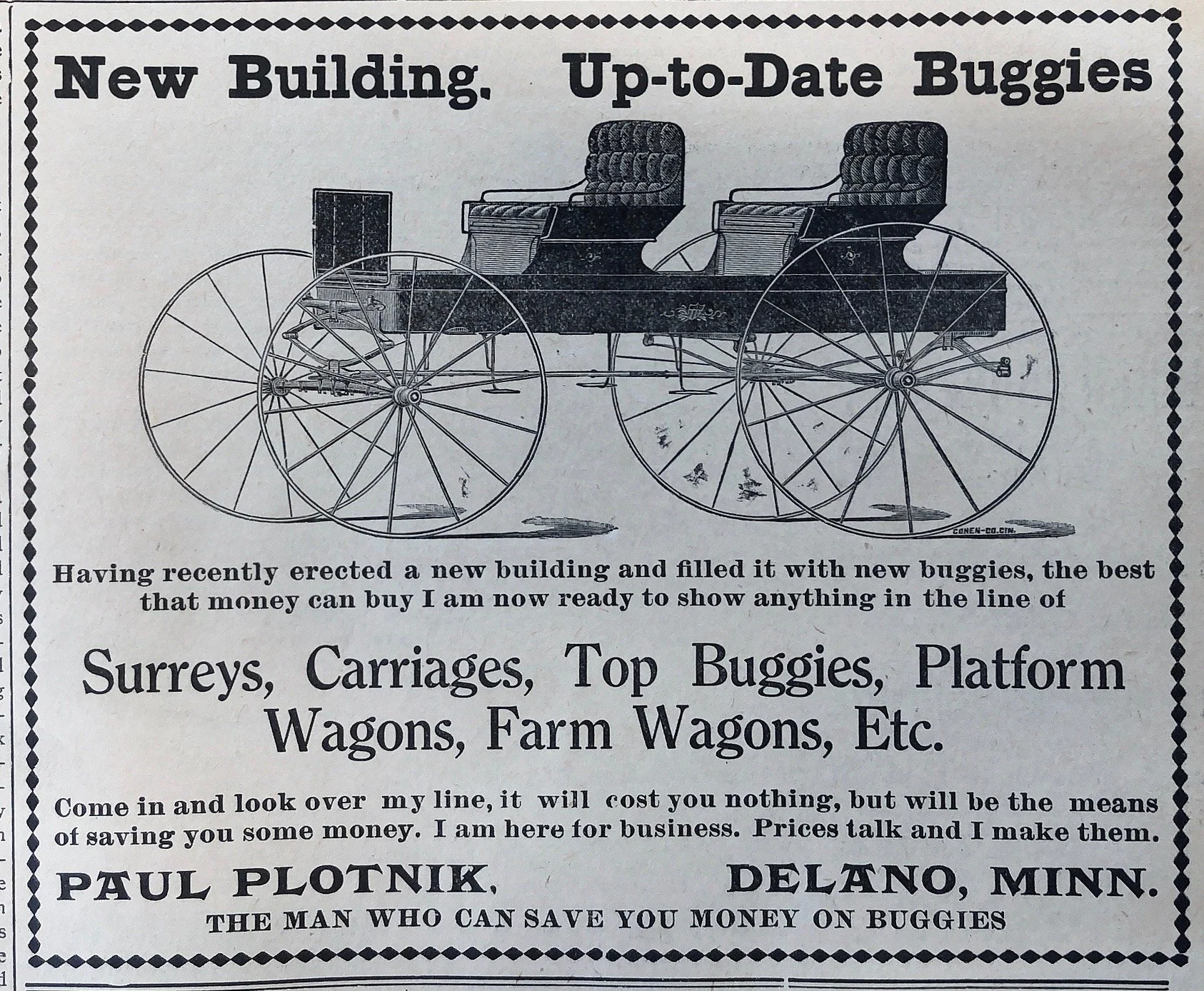
In this 1910 advertisement from the Delano Eagle, Plotnik advertised his new building, “Up-to-Date” buggies, surreys, carriages, top buggies, platform wagons, and farm wagons.
Paul built a new shop on Highway 12 in 1933. The new facility represented Plotnik’s transition from the agricultural period when horse-drawn equipment was locally constructed and repaired using traditional blacksmithing techniques such as the forge and anvil. In the early 20th century, Plotnik responded to changing agricultural practices by providing welding services and using belt-driven equipment. It was a thriving business. In 1945, after service in World War II, son, George, took over the family business. As the demand for blacksmithing services diminished, George branched out, fabricating flagpoles, swing sets, church projects, picnic tables. Examples of Plotnik’s craft dot the community, including the three original flag poles at the Delano City Hall.
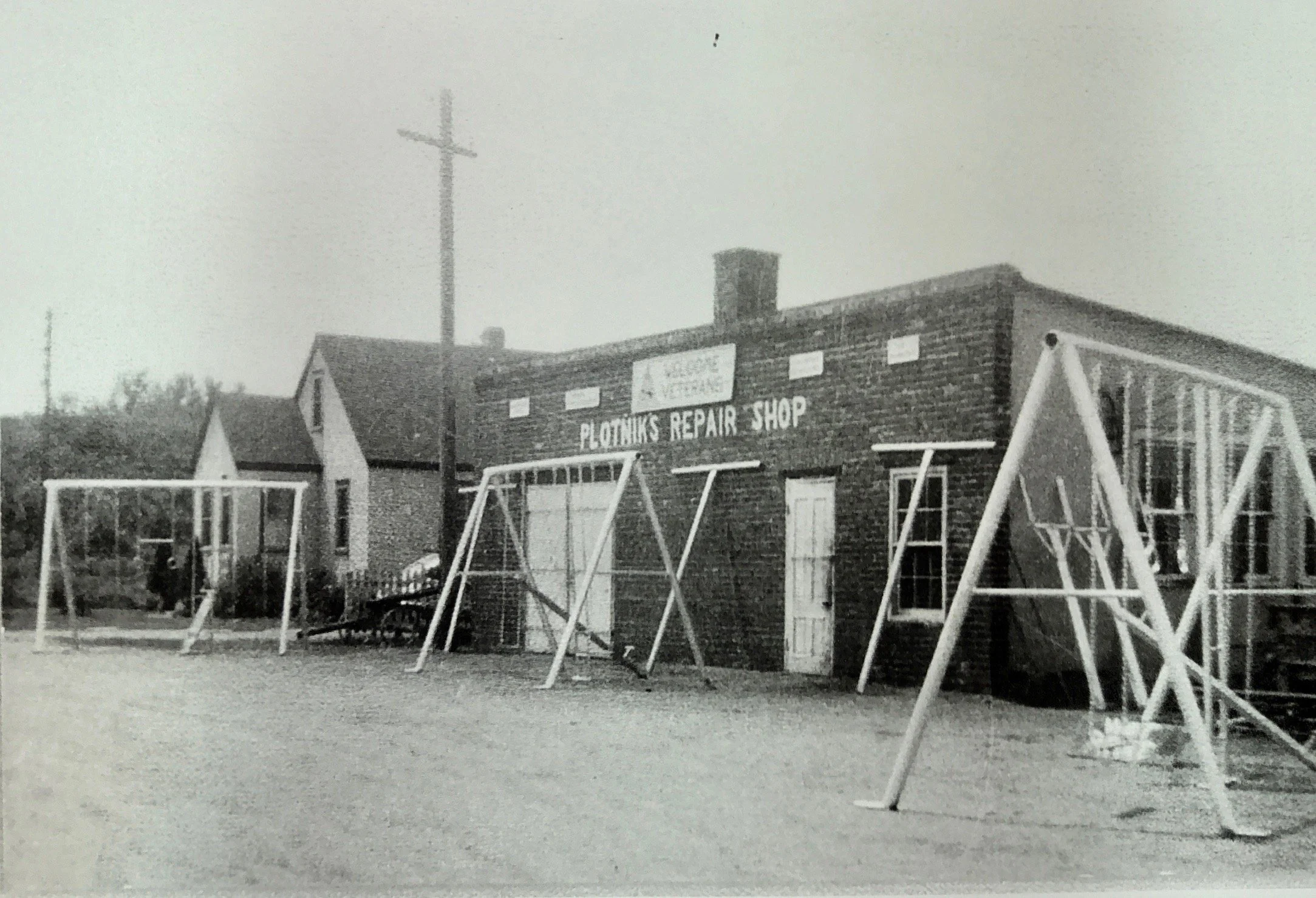
A nineteenth century blacksmith shop bears little likeness to today’s technological/digital industries. The shop is a monument to a pioneering spirit that spanned three centuries, and brought agriculture, commerce, industry and services to area communities. Now in its third generation, the family name, in hand-crafted letters, stands out among the neon lights and automated messages that populate Highway 12. Grandsons Tim and Tom Plotnik continue to operate the blacksmith shop on a part-time basis. Tim constructed a flagpole by his parents’ head stone in St. Joseph’s cemetery.
Paul Plotnik contributed to the community by his support of retail growth. He was the inventor of the Plotnik patent hay rack. He was one of the organizers and helped build St. Joseph’s Church of which he was a member. Because he had the unusual skill of fluency in four languages, as a side line, Plotnik worked as an interpreter in the Wright County Court system. Locally, he was considered both a laborer and a linguist and was helpful as the population increased. Paul Plotnik was a charter member of the Delano fire department when it was formed 1896.
An early sign of the Plotnik’s influence in the community was his support for our country’s defense efforts. His son Charley served in World War I and was one of the first commanders of the Delano American Legion. After George returned from World War II, he took over the family business. One of George’s first projects was construction of a “Welcome Veterans” sign. The modest sign takes on significance as travelers on Highway 12 are reminded of our common history and feelings.
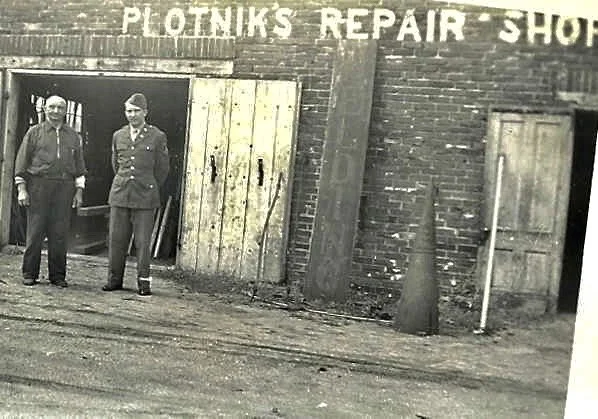
George was a member of the Delano American Legion.
Crafted by trained hands, engineered by imagination, livelihood, and necessity, Plotnik’s trademark was seen throughout the community and neighboring rural areas. The passing of time has not diminished the impact of strong hands, hard work, and skilled metallurgy. The old-fashioned images of a blacksmith as a specialist in the metal trades working mainly with iron and steel using a forge for soldering is a familiar local memory. The vivid images of hammering, pounding, smithing, and shaping tools and devices, swing sets, plowshares, pillars and gates, lattice and grills to furnish homes, farms, schools and businesses are an aspect of daily life in the community. The vast metal industry was essential to the progress of the country. It produced and continues to produce massive structures such as freeways and skyscrapers, industrial and commercial buildings, rocket ships, bridge decks, and military equipment and the countless columns, poles and pillars across the nation that support the heartbeat and the lifestyle of America and the Delano community.
Well into the future passersby on the highway will slow down, stop, glimpse, and feel. Altered only slightly by the weight of time, the Blacksmith shop pays homage to pioneer times, courageous people, hard work and metal and stone. If you visited the blacksmith shop today, you would see relics of industry and human effort. A tour of Delano today will discover and uncover many historic sites. Plotnik’s Blacksmith shop is an icon of people and progress, of art and architecture that withstands time. Much has changed. Much has remained the same. - Ted May
Paul Plotnik and his wife Elizabeth (nee Lyrek) were the parents of eleven children. Paul died in 1948.

The content of this page is brought to you by the Delano Spirit of Community Trail Committee in honor of Delano's 150th Anniversary.